
IT in M&A as a Lever for Sustainable Success
Every corporate transaction represents a strategic turning point—and a rare opportunity to rethink the IT foundation. Those who view M&A processes not merely as a mandatory exercise, but as a genuine technological fresh start, secure the future viability of their company.
Whether it’s a merger or a separation, the role of IT in M&A projects determines far more than just the smooth execution of the deal. It defines how resilient, scalable, and innovative a company can be following the transaction. In this article, we share practical insights from our consulting experience—helping you identify opportunities, avoid potential pitfalls, and leverage IT as a strategic driver—going well beyond standard checklists and conventional, routine thinking.
Separation at Daimler Truck – Modern IT as an Enabler for Global Scalability
When the Daimler Group—as part of its split into Mercedes-Benz and Daimler Truck—needed to separate its long-established IT landscape into two entirely independent entities, we played an active role as lead architects. Our objective was to decouple Daimler Truck from the existing infrastructure while maintaining ongoing operations and avoiding any system downtime, all while building a modern, scalable “greenfield” IT environment.
The result: A cloud-optimized infrastructure, a robust zero-trust security framework, and a comprehensive identity governance model now form a stable foundation for this new global beginning—supporting over 100,000 securely connected employees worldwide, reimagined processes, and an IT landscape that effectively integrates agility, security, and compliance.
In addition to identity governance and secure messaging, our teams implemented effective end-user communication strategies and digital enablement platforms from the outset, ensuring that all user groups could navigate the transition securely and efficiently.
The Underestimated Disruption
Many M&A processes are delayed or exceed their projected budgets because the duration and complexity of the IT component are frequently underestimated compared to other factors. The reason for this is that creating a new digital “nervous system” for the merged organization often requires deconstructing and analyzing the IT landscape that has evolved over the previous 20 years. Failing to realize—until it is too late—that IT is not merely an enabler, but the actual nervous system of a new corporate entity, puts the organization’s future viability at risk. Time constraints, entrenched silos, disparate systems, and uncertainty regarding the target architecture turn “Day One readiness” into a monumental challenge. The risk: instead of integration, new layers of complexity emerge; instead of innovation, the result is stagnation.
A crucial, early-stage steering mechanism is therefore a clear vision for the IT strategy and landscape—one that serves as a consistent guiding principle throughout the process for every aspect of the new IT environment. This includes, for example, well-defined identity governance models that ensure permissions, roles, and security mechanisms are clearly established from day one. Furthermore, modern collaboration and communication platforms must be integrated from the outset to guarantee functional and secure working structures for all stakeholders.
Five Areas of Action That Truly Matter in M&A
When IT is approached strategically from the very start of a transaction, a mandatory task can be transformed into a value-adding opportunity. Our consulting experience consistently shows that future-proof organizations involve IT teams early on, define ambitious target states, and leverage this “greenfield” scenario to drive comprehensive, sustainable modernization. Based on this, we have identified five areas of action that can help ensure the success of any M&A project.
IT Strategy & Organization
IT is shifting from a cost center to a value creator. Early integration into the transaction’s target structure, a clear derivation of IT requirements from the planned business model, and the establishment of dedicated guiding principles turn this transformation into a sustainable investment. One immediate “quick win” is to create an IT governance snapshot during the due diligence phase, allowing for a precise assessment of the target state, resource requirements, and critical dependencies. All of this is guided by one central question: Do the orientation and capabilities of the new IT organization contribute to the company’s overall strategy?

Architecture & Infrastructure
Greenfield approaches make it possible to shed legacy technical debt and build cloud-native, scalable solutions from the ground up. Organizations that have the courage to incorporate modernization and highly automated operating models from the outset gain a sustainable competitive advantage. The foundation for this includes a rigorous cloud-first strategy, a security-driven organizational structure, and processes that are digitized, automated, and augmented by AI from the very beginning.
Modern IT services—such as secure messaging or collaboration platforms—form the operational backbone of this new organization. Addressing these early on boosts efficiency, user adoption, and stability in equal measure; here, technical architecture and organizational change are inextricably linked. At the same time, as a digital foundation for communication, these services must offer the highest levels of reliability and security, and they are relevant to every single employee.
Data & AI Capabilities
In many M&A projects, the handling of data assets is treated as a mere formality—a perspective that leads to an underestimation of their true synergy potential. In forward-looking projects, by contrast, we view the early analysis of the data landscape as a strategic investment in future analytical, integration, and AI capabilities. A harmonized data infrastructure not only facilitates the realization of synergies but also establishes the operational foundation for data-driven innovation and a sustainable data strategy.
Cybersecurity & Compliance
In M&A projects, “security-by-design” is rarely prioritized voluntarily—usually, it only gains attention once risks become acutely apparent. Yet, this is precisely where one of the most significant opportunities lies for ensuring stability and manageability from an early stage. Concepts such as Zero Trust, identity governance, and end-to-end visibility across access points and systems should be established as mandatory guardrails from the very beginning. Our consulting experience consistently shows that when building new structures, the most cost-effective approach is to implement these security measures as early as possible; retrofitting based on findings from later audits is invariably more expensive in the long run.

People, Communication & Change
Technical solutions alone are not enough—the real challenge lies in transforming the organization and the way people work together. M&A projects only reach their full potential when business units and IT teams are involved early on, actively empowered, and supported; this, in turn, ensures that the end users—those most directly affected—receive the best possible guidance through the change process. IT-driven change requires leadership, targeted storytelling, and new communication formats. One proven, practical approach is the creation of an interactive digital change dashboard that provides transparency regarding project progress, upcoming milestones, and key change-related topics—accessible to all stakeholders at any time.
Best of Consulting Award for Comma Soft – Excellence that impresses
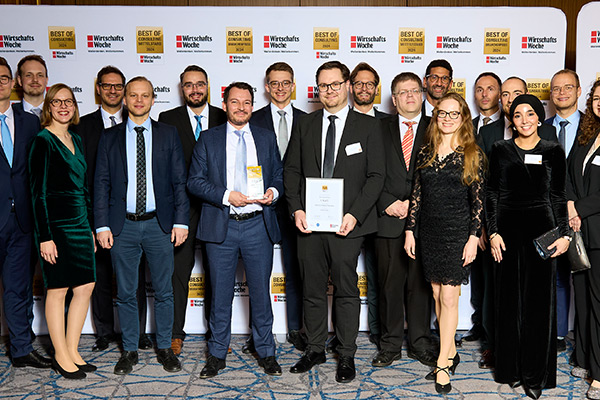
Our work for Daimler Truck was awarded 1st place in the “Technologies” category of the WirtschaftsWoche “Best of Consulting” awards. This external seal of quality carries significant weight, as it is based on direct feedback from independent consulting clients. The project itself underscores the strategic importance of modern IT in complex corporate initiatives—establishing Comma Soft as the go-to partner for innovative, secure, and scalable IT solutions.
Managing Stakeholders, Anticipating Risks, Ensuring the Ability to Act
M&A projects rank among the most demanding IT transformations: intense time pressure, incomplete baseline data, parallel decision-making tracks, a legacy of technical debt, and constantly shifting parameters all necessitate a consistently flexible management approach. Rather than relying on rigid project plans, success requires the ability to navigate uncertainty productively and maintain the capacity to act. For this reason, we have found the principle of “Minimum Viable Integration” to be highly effective: creating viable interim results quickly, prioritizing critical functions, and securing technical and organizational integration step-by-step—all while keeping the overarching strategic architecture in view.
Poor decisions often arise when technical, organizational, and cultural issues are addressed in isolation. It is therefore essential to develop “guiding principles” for IT transformation from a holistic perspective—covering everything from infrastructure and staff-enablement platforms to role-and-permission models and communication strategies. Implementing “early-warning systems” for stakeholders is particularly effective; these help identify critical conflicts of interest between IT and business units before they lead to operational friction.
Pitfalls such as shadow IT, underestimated licensing costs, or cultural misalignment can be mitigated early on through rigorous stakeholder management, clear technical standards, and tightly managed governance models. Finally, end-user enablement—facilitated by digital knowledge platforms, interactive guides, or targeted training—plays a decisive role in ensuring that IT-driven change is perceived not as a threat, but as a starting point for new ways of working. For one thing is always clear: M&A processes represent an enormous disruption for every single person in the company.
“A separation is always a unique opportunity to address the IT landscape of the past ten years and to build a secure and productive digital foundation for the next ten years.”
M&A as a Springboard for Future-Proofing Your Digital Capabilities
Viewing IT as a catalyst for transformation during M&A transactions does more than just build technical resilience; it lays the foundation for genuine innovation and long-term competitiveness.
With every deal, your responsibilities—regarding security, compliance, culture, and sustainability—increase. The good news is that the opportunities to actively shape your company’s future through a smart technology reset have never been greater.
Would you like to learn more, explore specific ideas, or are you currently facing an M&A-related challenge? Let’s talk—together, we can develop the IT foundation you need for a digital future.