
SÜDVERS
AI in Action: How Insurance Broker SÜDVERS Is Transforming Claims Processing
October 2026
At a Glance
Client: SÜDVERS, an international expert in risk and insurance
Industry: Insurance, Insurance Brokerage
Challenge: Manual, cross-system entry of unstructured claims reports—received via email—into an on-premise core system. This process was time-consuming, inefficient, and offered no added value.
Solution: Modular AI automation based on Microsoft Azure. Specialized AI agents handle data extraction, verification, loss estimation, entry into the core system, and preliminary communication.
Results: An “agentic AI” use case implemented under real-world conditions: automated end-to-end processes—from the initial email to the creation of a case file—while maintaining full human oversight (“human-in-the-loop”). The project serves as a proven technical blueprint for future AI applications at SÜDVERS.
Challenge
Manual Claims Entry
For insurance brokers, the process of entering claims often entails an extremely high administrative burden while offering little in the way of direct value creation. Manually transferring data is time-consuming and prone to error; estimates—based in part on data from the GDV (German Insurance Association)—suggest that claims handlers spend roughly half their working hours on tasks that do not require genuine professional insurance judgment. Furthermore, the processing phase typically spans several days to several weeks, often delaying the entire settlement process. This has a tangible negative impact on service quality and customer satisfaction, and can even lead to customer churn: more than two-thirds of all policyholders consider their experience during the claims process to be a decisive factor in their loyalty to their provider. In addition, many insurance organizations lack consistent, end-to-end standardization in their processing workflows. When it comes to estimating claims, many firms rely on “gut feeling” or the individual experience of specific claims handlers, which leads to inconsistent quality in the outcomes.
This is precisely where SÜDVERS identified a need for action. The core of claims processing at SÜDVERS is the broker management system OASIS, which is operated on-premises in the company’s own data center and is therefore not directly accessible via the cloud. This system landscape is supplemented by additional applications for managing contract details and a document archive.
Previously, the process for entering and handling claims functioned as follows:
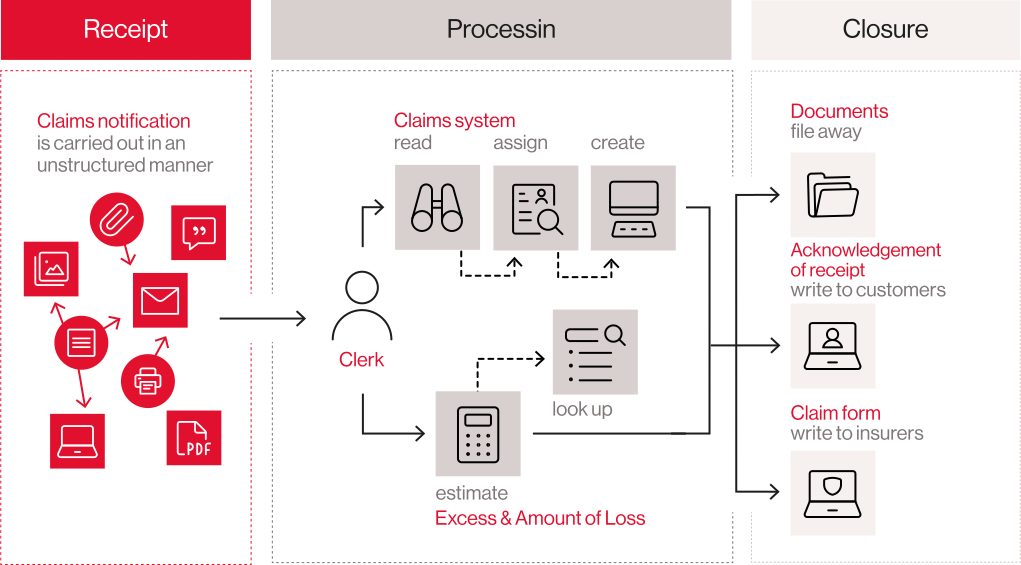
The central challenge in automating the process lay in converting unstructured emails into accurate system data and securely connecting a core system that was not accessible via the cloud. At the same time, the project was intended to serve as a “beacon” for SÜDVERS’ AI initiative: it had to be both visible and feasible, acting as a model for future use cases. To ensure visibility, we worked with the client to select a specific use case that covers a key core process across various insurance divisions, thereby making the approach transparent and relevant throughout the entire business. Regarding feasibility, we deliberately chose a more complex process logic—while avoiding the integration of too many legacy systems. This allowed us to demonstrate that we can handle complexity and successfully bridge the gap between a relatively new technology—generative AI (GenAI)—and the legacy system, OASIS.
Solution Approach
Modular AI Automation as a Path to Efficient Processes
Comma Soft provided methodological support to SÜDVERS throughout the entire journey—from selecting the use case to achieving full operational deployment. Various options were prepared and presented in a structured format to serve as a basis for decision-making, while SÜDVERS retained final control.
-
The process began with a use-case discovery phase, conducted in collaboration with staff from the specialized claims department. A broad collection of potential use cases was evaluated based on visibility, acceptance, technical feasibility, and business impact. A deliberate, focused start paved the way for quick wins: development initially centered on a single cause of loss—in our case, tap water damage—before the system was expanded incrementally. The department was involved throughout the entire process; staff described the current state (as-is) in interviews, worked with us to define the target state (to-be) process, and conducted live tests using actual claims. This allowed for the iterative refinement of business rules—such as those for classifying the type of loss—based on real-world, operational cases.
Automated Processes with Full Human Oversight
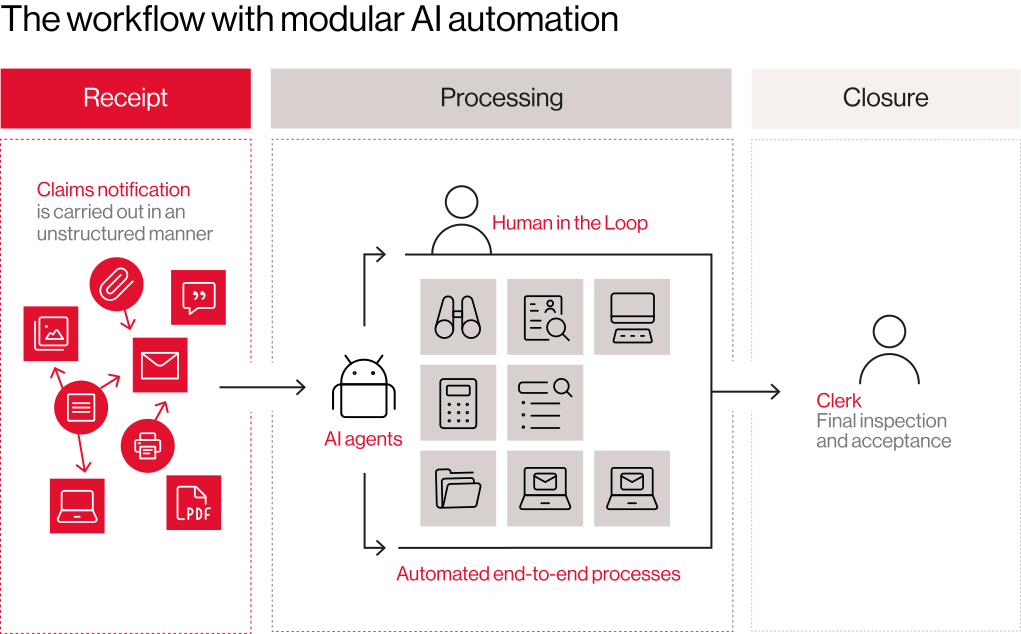
Specialized process automations leveraging generative AI are executed via Azure AI Foundry—a platform for developing AI applications—with hosting provided in Germany. Each agent is assigned a specific task, such as extracting data from emails and attachments, estimating the value of a loss, or analyzing photographs of damage. While these agents provide data points, they do not make autonomous decisions. Control is governed by process logic implemented through Logic Apps. Consequently, security-critical data—such as contracts and deductibles—remains within existing systems; it is not uploaded to the AI as documents but is merely accessed for reading. The AI’s role is limited to determining the process flow—selecting the appropriate path within the decision tree. For instance, it decides whether a claim should be registered automatically due to clear-cut circumstances, or whether it requires review by a human claims handler; it also determines whether an email should be sent to the insurer, or if such a step is not (yet) necessary. For every case, a human-readable processing log is automatically generated, documenting exactly how the AI arrived at an estimate or why a case was escalated to a human staff member. Through a “human-in-the-loop” approach, control remains firmly in human hands rather than being delegated to the AI.
"With fascinating precision, AI handles the extraction of external and internal content—as well as the redundant manual data entry that would otherwise follow—all while ensuring we retain full control over the subject-matter expertise. In particular, the transparent logging of every decision provides us with the level of assurance that is absolutely essential in a regulated environment."
Results and Benefits
A Blueprint for the AI Roadmap
The implementation demonstrates how generative AI can be successfully deployed in a regulated environment alongside on-premise core systems. By focusing on a tight MVP (Minimum Viable Product) scope and an iterative approach, the solution was delivered in just three months—from initial requirements gathering to go-live—rather than through a protracted, large-scale project.
This specific step in the claims-handling process is now fully automated, end-to-end: Upon receipt of an email, the system automatically generates a claims file, establishes line items (including reserves), creates a task with a follow-up reminder, and drafts the necessary communications for both the client and the insurer.
The AI-based claims estimator proved particularly impressive during live testing: Previously, claims estimation relied on the experience and intuition of a staff member. This estimate dictates the subsequent course of the claims-handling process—for instance, triggering a requirement for an expert assessment if the estimated value exceeds €5,000. In contrast, the AI claims estimator breaks the estimate down into smaller components to calculate more granular steps for resolution. This allows for a transparent breakdown of costs across different trades or service categories.
Human oversight remains absolute: The system includes rule-based handoffs for cases involving uncertainty, and every action is logged, ensuring full transparency throughout the process.
For SÜDVERS, this flagship project serves as a proven operational model and an architectural blueprint for its broader AI roadmap. The success of the initiative has fostered strong mutual trust among the teams involved, effectively dismantling the traditional silos that once separated IT from the business units. Furthermore, the success of this flagship project has demonstrated that generative AI can deliver impact even within well-established, legacy systems:
The true success of this project lies in the symbiosis between our proven legacy systems and state-of-the-art generative AI. We have demonstrated that we can automate highly complex, regulated processes without compromising security or human oversight. In doing so, we have established a stable foundation and a scalable architecture for our entire AI roadmap.
Thomas Riehmer, Project Sponsor & Executive Management, SÜDVERS
The true success of this project lies in the symbiosis between our proven legacy systems and state-of-the-art generative AI. We have demonstrated that we can automate highly complex, regulated processes without compromising security or human oversight. In doing so, we have established a stable foundation and a scalable architecture for our entire AI roadmap.
Are you also planning to automate your business-critical processes using modular AI agents?
We support you in identifying your own flagship use case and bringing it into production quickly.