
Generative AI in engineering product development
How companies are rethinking speed, quality and expertise
At a glance
-
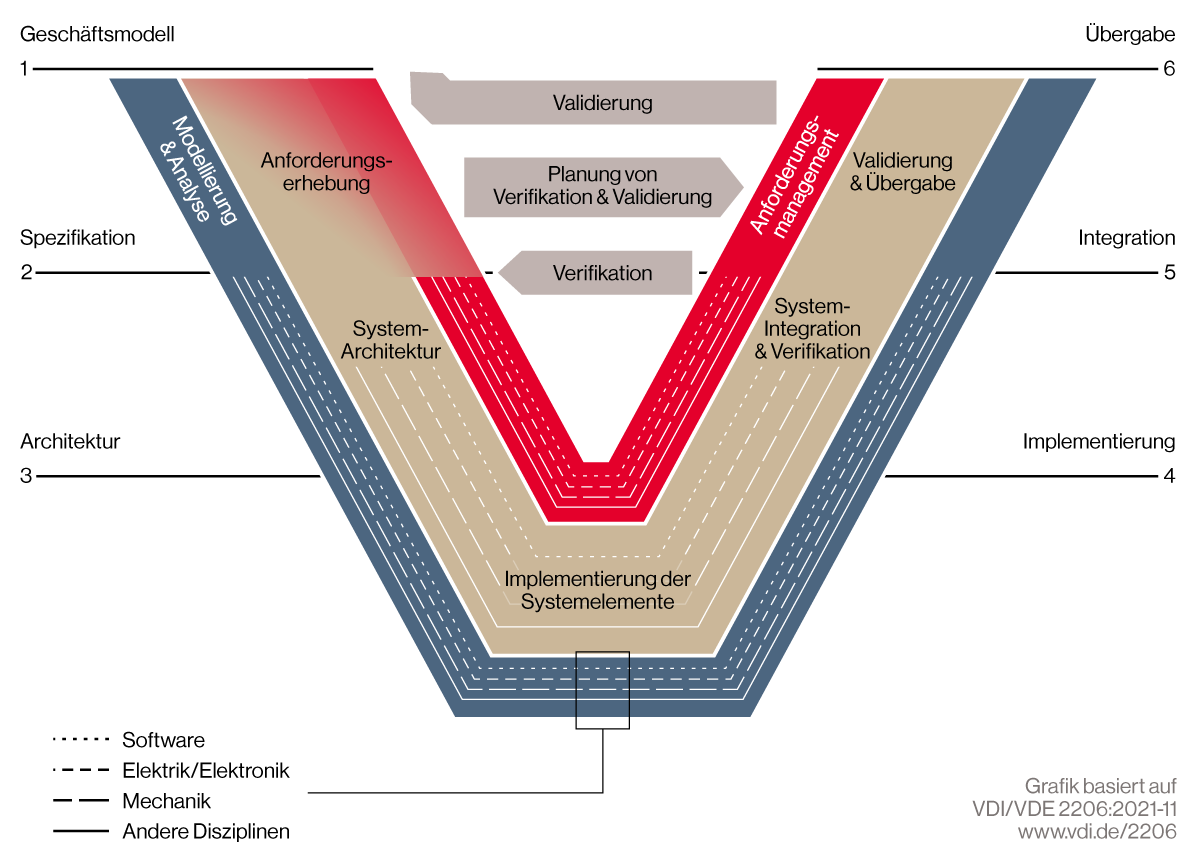
Engineering-led product development based on the V-model is characterised by a high degree of interdependence between disciplines (mechanical, electrical/electronic, software) and the relationships between their deliverables. Requirements, system architectures, functional models, simulation results and bills of materials are created in different engineering tools (e.g. CAD, CAE, PLM) and are often only loosely linked, if at all. End-to-end traceability across artefacts – from requirements to verification – is rarely implemented consistently. Changes do not propagate reliably throughout the system landscape, leading to inconsistencies, redundant work and increased verification effort. At the same time, domain-specific knowledge is often not formalised, but is embedded in individual modelling decisions, calculation logic or the experience of experts.
The challenge
Engineering caught between complexity and speed
As part of a study, we conducted several interviews with engineering and AI experts from industry and research, reviewed the current literature (AI in New Product Development, Fraunhofer & PwC) and consolidated our experience from client projects. This revealed that the understandable desire for a fully automated engineering process is currently and predictably unrealistic – and, in practice, unnecessary. The greatest value is created where local optimisation through generative AI is integrated into the holistic engineering process.
Three structural barriers to the value-adding implementation of generative AI in product engineering stand out in particular:
- Fragmented tool landscapes
Each tool provider uses its own data models and interfaces, which makes seamless data exchange difficult. There is usually no company-wide data standard. - Lack of consistency and traceability
Document-based development leads to media discontinuities, redundancies and a lack of traceability for requirements, simulations and tests – a major obstacle to efficiency. - Tacit knowledge and distributed information flows
Decades of practical knowledge is often confined to individual minds or buried in documents, rather than being available in a structured, managed format. AI can only make use of this knowledge today if it is systematically captured and explicitly stored in a central repository.
Against this backdrop, it becomes clear that the future does not lie in fully autonomous engineering, but in an intelligent interplay between human expertise, structured knowledge and generative AI.
Approach
Generative AI throughout the entire engineering workflow


AI-powered requirements engineering – ensuring quality at the outset increases the rate of reuse
Many of the problems that arise later on are rooted in the requirements themselves. The interviews show that requirements are often incomplete, redundant or ambiguously worded. Generative AI comes into play precisely here: it structures requirements, identifies inconsistencies and processes information from stakeholder discussions more quickly and accurately. Semantic search methods ensure that existing requirements and approved solutions are reused rather than redeveloped – a huge efficiency driver. AI always acts as an assistance system in this context: it reduces the workload but keeps humans involved in the validation process.


From Text to System Model: AI as an Introduction to Model-Based Systems Engineering (MBSE)
Many companies would like to make the transition to model-based systems engineering, but struggle to get started. AI can play a crucial role here by converting free-text requirements into structured SysML models, thereby creating a basic framework that engineers can then flesh out in greater detail. This creates transparency regarding relationships, dependencies and ambiguities that remain hidden in document-based processes. In practice, this usually applies only to clearly defined domains, good data sets and narrow use cases. Whilst complete system models still require technical expertise, the AI-supported generation of subsystems is now a realistic prospect and has already been established in pilot projects.


Hybrid AI simulation and digital twins: From solvers taking hours to real-time analysis
Simulations are among the most time-critical steps in engineering. Traditional finite element method (FEM) and computational fluid dynamics (CFD) calculations often take many hours. AI-based surrogate models are revolutionising this by enabling new variants to be evaluated in seconds based on historical data. Combined with live digital twins, this creates a dynamic learning cycle: real-world operational data feeds back into the models, simulations are automatically triggered anew, and design changes are evaluated at an early stage. The interviews show that this is precisely where the greatest potential for efficiency lies – not through revolution, but through accelerated iterations.


A new approach to design: generative design and early validation
Generative design – strictly speaking, not GenAI but rather machine learning – already makes it possible, in some cases, to generate hundreds of variants in a matter of seconds, all of which are optimised simultaneously in terms of weight, stiffness, installation space or cost. At the same time, AI can automatically detect geometric issues – such as collisions, tolerance violations or details unsuitable for simulation – at an early stage. This makes it possible to avoid time-consuming manual preparation for simulations in the future. The result: radically shortened design cycles, fewer prototypes and significantly greater variant coverage.

Finally putting engineering knowledge to use: knowledge graphs & agent-based AI
A key insight from the interviews is that even the best AI is ineffective without structured knowledge. Companies such as Rosenberger are therefore already turning to agent-based AI systems that rely on curated knowledge graphs and retrieval techniques. These systems make it possible to provide technical and process knowledge in a context-sensitive manner throughout the entire engineering process and to utilise it in AI workflows. Multimodal models deliver additional benefits by automatically extracting and structuring information from technical drawings, scans or complex symbols, thereby making it more searchable and interpretable. Crucially, however, this knowledge base must be continuously built up and maintained – a strategic governance task, not merely a technology project.

Results
What generative AI is truly capable of today
The experts agree:
- AI currently acts as an assistant, not as an autopilot. Many steps can be sped up, but not fully automated. Not every engineering step benefits equally from generative AI.
- The greatest efficiency gains are initially achieved locally within the V-model, but must ultimately fit into an end-to-end approach. Only when the individual process steps of the V-model are fully integrated can measurable added value be achieved.
- Data, knowledge and experience are the key to success – provided they are harnessed for AI. AI is only as good as the context provided.
- The future of engineering remains in human hands, but strongly supported by AI-based assistance systems that boost speed and quality, thereby creating scope for creativity.
Conclusion
Now is the right time to make effective use of generative AI in product engineering
Generative AI is transforming engineering product development – not through radical upheavals, but through pragmatic, immediately effective measures integrated into existing workflows. The technology is mature enough to deliver measurable benefits, and new enough to give companies a real competitive edge in innovation right now.
We support companies precisely at this stage:
through process analysis, foundational data work and the targeted integration of generative AI approaches, which significantly reduce the workload on engineering teams, improve the quality of decision-making and accelerate product development.